
Premium Tennis Court Construction Services
SVD Sports Construction delivers premium tennis court construction solutions designed for clubs, schools, resorts, academies, residential communities, and commercial sports facilities. Our approach combines accurate court planning, strong base preparation, quality sports surfaces, professional finishing, and long-term performance. Every project is developed around the available site, playing requirements, drainage conditions, lighting needs, and overall design vision.
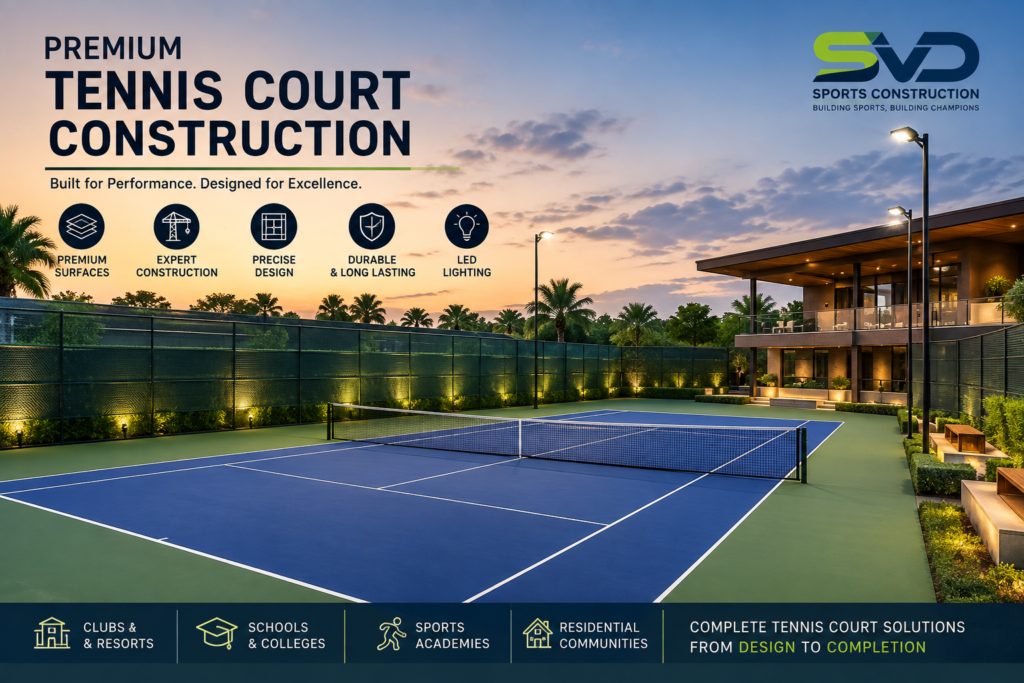
Why Choose Our Tennis Court Construction Services?
A high-quality tennis court is more than a painted playing surface. It requires a carefully engineered foundation, accurate dimensions, proper water drainage, reliable fencing, and a surface system selected for the intended level of play. Our tennis court construction process is planned to create a clean, premium, safe, and consistent playing environment.
We focus on detail at every stage, from site preparation and base construction to surface application, line marking, fencing, lighting, and final inspection. This helps create a court that looks sophisticated while supporting comfortable movement and dependable ball response.
Professional Court Planning and Design
Our tennis court construction projects begin with site assessment and layout planning. We review the available area, ground condition, access, slope, drainage, orientation, surrounding structures, and future maintenance requirements. The playing court is planned according to recognized tennis dimensions, while additional clear space is considered around the court for safe player movement and facility circulation.
We can develop solutions for single courts, multiple-court facilities, training academies, resorts, schools, clubs, and premium residential developments. The final design can also include spectator areas, player seating, pathways, fencing, lighting, landscaping, and supporting amenities.
Premium Tennis Court Surface Options
The right surface can significantly influence the feel, speed, maintenance, and appearance of a tennis facility. Depending on the project, our tennis court construction solutions can incorporate professional acrylic systems, cushioned acrylic surfaces, synthetic options, or other suitable surface specifications.
Acrylic court systems are popular for their clean appearance, controlled texture, and practical maintenance requirements. Surface selection should always consider climate, usage frequency, player requirements, drainage, and the desired playing characteristics. We help clients select a suitable system instead of applying a one-size-fits-all solution.
Engineered Base and Drainage
Long-term tennis court performance starts below the visible surface. Our tennis court construction methodology emphasizes proper excavation, compaction, sub-base preparation, leveling, drainage planning, and a stable playing base. These stages help reduce unwanted settlement, surface irregularities, and water-related damage.
Effective drainage is especially important for outdoor courts. We plan suitable slopes and drainage arrangements based on the site so rainwater can move away from the playing area efficiently. A properly prepared foundation provides a stronger platform for the final sports surface.
Fencing, Lighting and Court Accessories
A premium tennis facility should feel complete from the moment players enter. We can integrate perimeter fencing, high-quality net posts, tennis nets, player seating, gates, LED sports lighting, and other court accessories into the overall tennis court construction package.
For evening play, lighting should provide consistent visibility without creating unnecessary glare. Fencing can be designed to provide security, ball containment, and a refined architectural appearance. These details can be coordinated with the surrounding landscape and facility branding.
Built for Clubs, Academies and Luxury Developments
SVD Sports Construction provides tennis court construction for a wide range of applications, including professional training environments, sports academies, educational institutions, hospitality projects, gated communities, corporate campuses, and private luxury properties. Our team can manage the project from initial consultation and design coordination through construction, finishing, and handover.
Our goal is to deliver a court that combines sporting performance with visual elegance. From premium surface colors and precise line marking to integrated lighting and fencing, every element can be planned to create a distinctive sports environment.
Why SVD Sports Construction?
Choosing the right construction partner can make a major difference in court quality and long-term value. Our tennis court construction approach emphasizes workmanship, material selection, accurate execution, site coordination, and professional finishing. We work closely with clients to understand their budget, purpose, design preferences, and expected usage before recommending the appropriate solution.
If you are planning a new tennis facility or upgrading an existing space, SVD Sports Construction can help transform your site into a premium playing environment. Contact our team to discuss your site dimensions, preferred surface, project requirements, and installation scope.
Contact SVD Sports Construction for Tennis Court Construction
Ready to build a premium tennis facility? SVD Sports Construction provides complete tennis court construction solutions for sports academies, schools, colleges, clubs, resorts, residential communities, and private developments. From site planning and foundation preparation to premium sports surfaces, fencing, lighting, net systems, and final finishing, we manage every stage with attention to quality and detail.
Whether you are planning a new tennis court or upgrading an existing facility, our team can help you select the right surface, layout, construction system, lighting, and accessories based on your site and requirements. We focus on creating courts that combine professional performance, elegant design, durability, safety, and long-term value.