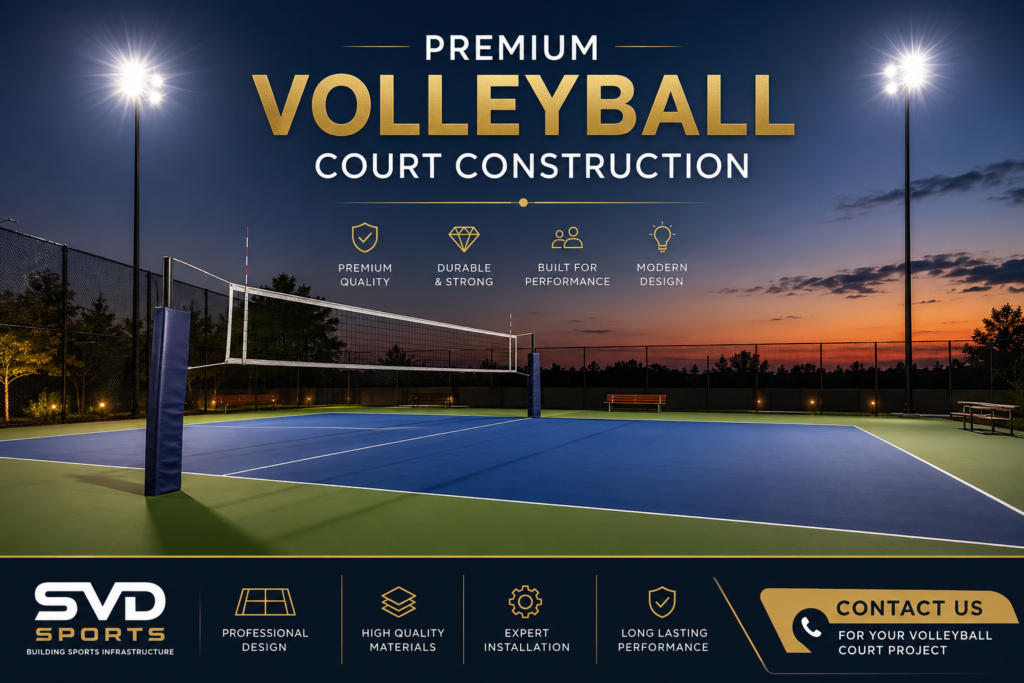
Premium Volleyball Court Construction
At SVD Sports, we believe a great sports facility should deliver more than a playing surface. It should create an environment where athletes can perform with confidence, communities can come together, and every game can be enjoyed at its best. Our Volleyball Court Construction solutions combine professional planning, quality materials, precision engineering, and premium finishing to create courts designed for performance, safety, and long-term durability.
Whether you are developing a sports academy, school, college, residential community, resort, club, or commercial sports facility, our team provides complete solutions from concept and planning to final installation. Every project is designed around your available space, usage requirements, budget, and desired level of performance.
Designed for Performance. Built for Durability.
Professional Volleyball Court Construction begins with proper planning. A high-quality court requires accurate dimensions, a stable foundation, effective drainage, suitable flooring, reliable net systems, and well-designed lighting. At SVD Sports, we take care of every important element to create a court that looks exceptional and performs consistently.
We design and construct volleyball courts for recreational, training, institutional, and competitive environments. Depending on the project requirements, we can provide complete outdoor volleyball courts, indoor volleyball flooring systems, and customised beach volleyball facilities.
Our approach focuses on creating a premium sports environment that combines functionality with a clean and professional appearance.
Precision Civil Works and Court Foundation
The foundation is one of the most important elements of Volleyball Court Construction. Before installing the final playing surface, the base must be properly prepared, levelled, compacted, and engineered for long-term stability.
Our construction process can include site preparation, excavation, sub-base development, concrete works, surface levelling, and drainage planning. For outdoor projects, proper water management is essential to protect the court surface and maintain its performance during changing weather conditions.
Every project is planned with attention to surface uniformity, durability, and long-term maintenance. This helps create a reliable base for the selected flooring system.
Premium Volleyball Court Flooring Solutions
Different facilities require different playing surfaces. Our Volleyball Court Construction services can include a range of premium flooring solutions based on the location and performance requirements of the project.
For outdoor courts, acrylic sports flooring provides a durable, professional, and visually attractive finish. It offers reliable grip, weather resistance, and a clean appearance suitable for schools, clubs, residential communities, and sports academies.
For indoor facilities and advanced training environments, PU and cushioned sports flooring can provide improved comfort and shock absorption. These systems are designed to support player movement while helping create a more comfortable playing experience.
We also provide solutions for beach volleyball courts, including site preparation, drainage planning, and suitable sports-grade sand systems.
Professional Net Systems and Court Accessories
A complete volleyball court requires more than flooring. Our Volleyball Court Construction solutions can include professionally installed net posts, adjustable net systems, removable sockets, boundary markings, fencing, and safety netting.
Adjustable net systems can support different playing requirements, while removable post systems can provide greater flexibility when the space is used for multiple activities.
For outdoor projects, we can also incorporate perimeter fencing and high-quality sports netting to help improve safety and maintain an organised playing environment.
Sports Lighting for Extended Play
A premium sports facility should remain functional beyond daylight hours. Our Volleyball Court Construction services can include professional LED sports lighting designed for clear visibility and comfortable gameplay.
The lighting layout is planned to support better illumination across the playing area while reducing unwanted dark zones. Depending on the facility’s requirements, we can recommend suitable lighting solutions for recreational play, training facilities, academies, and competitive environments.
Proper pole placement and lighting distribution can also enhance the overall appearance of the facility and create a more professional atmosphere.
A Complete Solution from Concept to Completion
At SVD Sports, we provide end-to-end Volleyball Court Construction services. Our team can support your project through planning, design coordination, civil works, flooring installation, sports equipment, fencing, netting, lighting, and finishing.
Instead of coordinating multiple contractors, you can work with one experienced team for your complete sports infrastructure project.
Our goal is simple: to transform an empty space into a high-quality sports destination.
Why Choose SVD Sports?
Choosing the right partner for Volleyball Court Construction is essential for achieving the right balance between appearance, performance, and durability.
With SVD Sports, you benefit from:
- Complete sports infrastructure solutions
- Professional planning and execution
- Premium flooring options
- Quality construction materials
- Customised solutions for every project
- Sports fencing and safety netting
- Professional lighting solutions
- Focus on durability and long-term performance
- End-to-end project coordination
Our Volleyball Court Construction team focuses on every stage of the project, from the foundation below the surface to the final finishing details that define the complete facility.
Build a Court That Inspires Every Game
A professionally designed volleyball court can become a valuable addition to a school, academy, residential community, resort, club, or sports complex. With the right planning and construction quality, your facility can provide years of reliable performance while creating a premium sporting experience.
Choose SVD Sports for Volleyball Court Construction that combines precision, performance, quality, and professional design.
From empty space to game-ready excellence, we build volleyball courts designed to perform and built to last.
Contact SVD Sports today to discuss your volleyball court project and receive a customised solution based on your location, available space, and requirements.